
Nike Doesn't Win Because AI Likes It
Before we worry about being found online, let's think about being wanted

James Cadwallader’s company, Profound, helps 13% of the Fortune 500 understand and control how AI talks about their brands.
His talk at Websummit this year was mesmerizing - I definitely leaned in. I’d say pretty much every founder in the room walked away thinking the same thing: how do I show up in ChatGPT?
Right question. Wrong level of the funnel.
Oh, How Quickly We Forget
Remember performance marketing?
Marketing technologists turned up their noses at the fuzzy stuff – story, emotion, meaning – and went all-in on the quantifiable data that told them what to tune about the message.
The data tells us what happened next.
Les Binet and Peter Field spent decades analyzing nearly 1,000 ad campaigns for the UK’s Institute of Practitioners in Advertising. Their findings: as brands shifted budgets toward short-term activation and away from brand building, overall marketing effectiveness fell. Emotional campaigns, it turned out, were nearly twice as likely to drive long-term profit growth as rational ones.
The industry had optimized its way into irrelevance. We called it data-driven. It was brand suicide on an installment plan.
The New Shiny Object Has the Same Problem
AI search optimization is bottom-of-funnel by definition. It doesn’t create demand. It captures it.
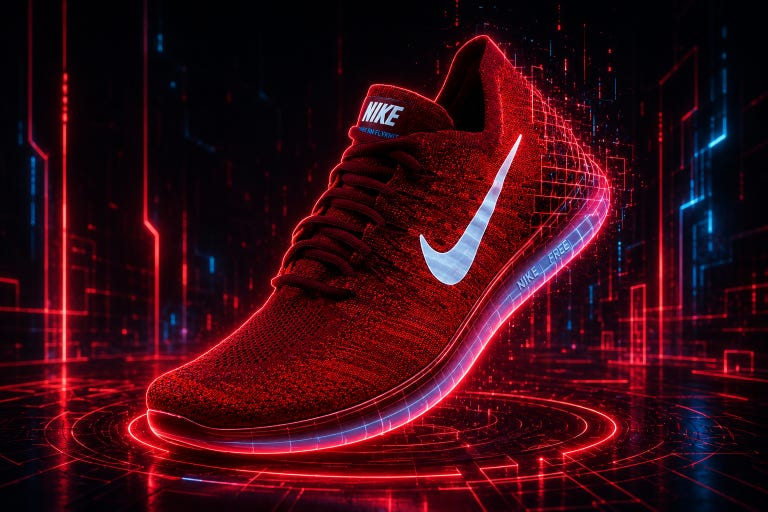
If you’re asking ChatGPT for running shoe recommendations, the brand battle is already over. The winner was decided years earlier, perhaps on a couch, when you watched a Nike ad and felt a twinge – if that kid could could find his greatness and start jogging, why can’t I?
Find Your Greatness didn’t show up in a search result. It showed up in a moment of vulnerability, and it lodged itself deeply in your psyche. A place algorithms can’t reach.
By the time the AI conversation starts, Nike had already won.
The Question Cadwallader Didn’t Ask
What creates the emotional precondition that makes someone predisposed before they open ChatGPT?
AI can only amplify what already exists in the world. If what exists is inconsistent, forgettable, or purely transactional, AI amplifies that. If what exists is clear, emotionally resonant, and distinct, AI amplifies that instead.
The algorithm doesn’t choose. It reflects.
The Asymmetric Bet Most Founders are Ignoring
Legacy brands have emotional reserves built over decades. They can afford to play both games – brand and AI optimization – simultaneously. Most founders can’t. They have no reserve.
Competing purely on AI visibility means a level playing field against every well-funded competitor doing exactly the same thing.
The only asymmetric move available is building emotional gravity before the AI conversation starts.
Make the customer predisposed to want you. Then let AI help them find you.
The Diagnostic
Ask yourself: if a potential customer described your company to ChatGPT right now, what words would they use?
Then ask: did you put those words into the world deliberately, with emotional weight behind them? Or did you build a website, write a sales deck, and hope the algorithm figures it out?
AI is a mirror. If you’ve built a brand that’s nothing more than generic phrases connected to spec sheets, you won’t like what AI reflects back to you.
The Counterintuitive Takeaway
The winners in the AI era won’t necessarily have the best optimization strategy. They’ll have the clearest, most emotionally resonant story, built upstream of the search, before the customer knew they were looking.
Because the predisposed customer is already yours. The unpredisposed customer is anyone’s game.
Same Lesson, New Classroom
We learned this with performance marketing. Painfully. The brands that survived were the ones that never stopped investing in meaning, even when meaning was (and continues to be) hard to measure.
AI search is a legitimate channel. Optimize for it. But if that’s your whole strategy, you’re building on sand.
The market doesn’t reward visibility. It rewards gravity. And gravity is built upstream, in the fuzzy, unmeasurable, irreplaceable work of making people feel something before they ever think to search.
Want to find me? You don’t need AI, just this link.